← Back to Places
Kilmainham Courthouse is a striking Georgian building that served as a court of law for nearly two centuries. Built in 1820 adjacent to Kilmainham Gaol, the courthouse was the place where countless defendants faced trial before being sentenced, often to imprisonment in the neighboring gaol.
The courthouse stands as an important architectural and historical monument, closely linked to the story of crime, punishment, and justice in 19th and early 20th century Dublin. Its proximity to Kilmainham Gaol means that many of the prisoners whose stories are told in the gaol museum first passed through these courthouse doors.
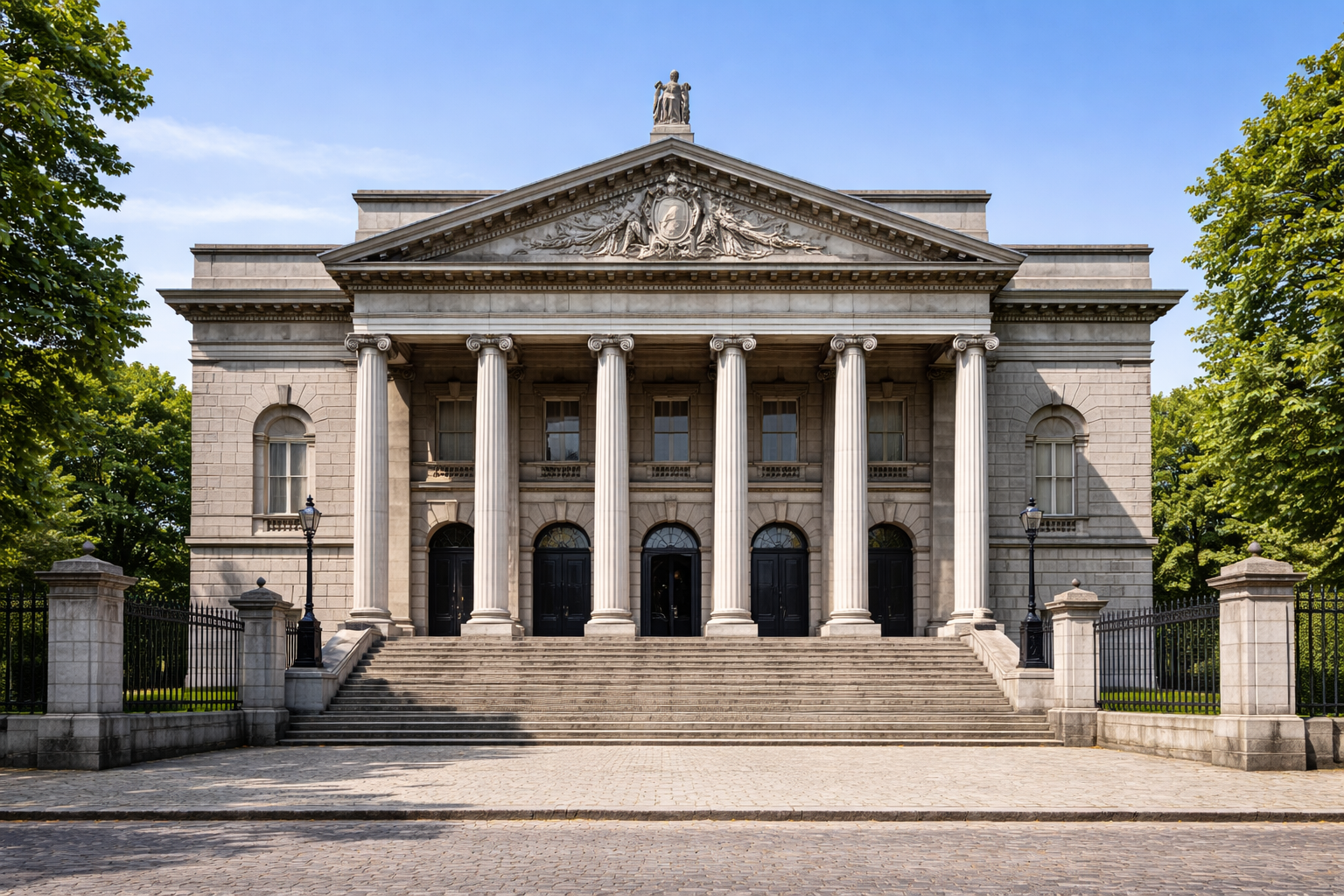
The courthouse was designed in the classical Georgian style, featuring a prominent facade with columns and a pediment that conveyed the authority and gravity of the law. The building's design was intended to impress upon all who entered the seriousness of legal proceedings.
Inside, the courthouse contained courtrooms, judges' chambers, and holding cells for prisoners awaiting trial. The main courtroom featured elevated seating for judges, a dock for the accused, and galleries for the public who came to observe proceedings.
The courthouse witnessed many significant trials throughout its operational history. Political prisoners, common criminals, and ordinary citizens all faced justice within its walls. Many of those convicted were escorted directly to Kilmainham Gaol next door to serve their sentences.
During the period of Irish revolutionary activity, the courthouse saw trials of nationalist activists and republicans. The connection between the courthouse and the gaol made Kilmainham a complete judicial complex, from trial to incarceration.
Kilmainham Courthouse operated as part of the Dublin County court system, handling both civil and criminal cases from the surrounding area. The types of cases ranged from minor offenses to serious crimes, with sentences varying from fines to transportation to Australia or, in extreme cases, execution.
The courthouse also handled petty sessions, where local magistrates dealt with minor offenses. These sessions were an important part of community life, settling disputes and maintaining order in the growing Dublin suburbs.
After the courts moved to more modern facilities, Kilmainham Courthouse fell into disuse. However, like the adjacent gaol, it has been preserved as a heritage site. The building has been carefully restored and now serves as part of the Kilmainham heritage complex.
Today, the courthouse is used for special events, exhibitions, and educational programs. Its restored interiors offer visitors a glimpse into the workings of 19th-century justice, while its connection to Kilmainham Gaol provides a complete picture of the Irish justice system of that era.